
A 50-State Typology of How States Identify and Finance High-Priority Programs
From List to Lever
Across the country, policymakers are increasingly focused on ensuring that higher education programs prepare students for successful careers and meet evolving workforce and economic needs. But how do states determine which academic programs are priorities, and what financial tools do they use to support them?
How are states aligning higher education investments with workforce priorities?
NOVEMBER 2026 | RESEARCH & INSIGHTS | HIGH-PRIORITY PROGRAMS
HCM Strategists' new 50-state analysis provides the first comprehensive, standardized framework for understanding and comparing state approaches to identifying and financing high-priority academic programs.
The research examines two fundamental dimensions of state policy:
Identifying high-priority programs: How states use labor market information, graduate outcomes, return-on-investment measures, and other criteria to determine which academic programs warrant priority attention.
Financing high-priority programs: How states use funding formulas, targeted investments, student financial aid, and other financial incentives to support designated programs.
Together, these dimensions provide a more complete picture of how states align higher education policies and investments with workforce, economic development, and broader societal needs. The typology also looks beyond traditional measures of high-demand, high-wage occupations and return on investment (ROI) to incorporate measures of social impact, recognizing the value of occupations that make significant contributions to society even when they offer lower earnings. This broader perspective provides policymakers with a more nuanced framework for assessing how states define and support high-priority programs.
State Results
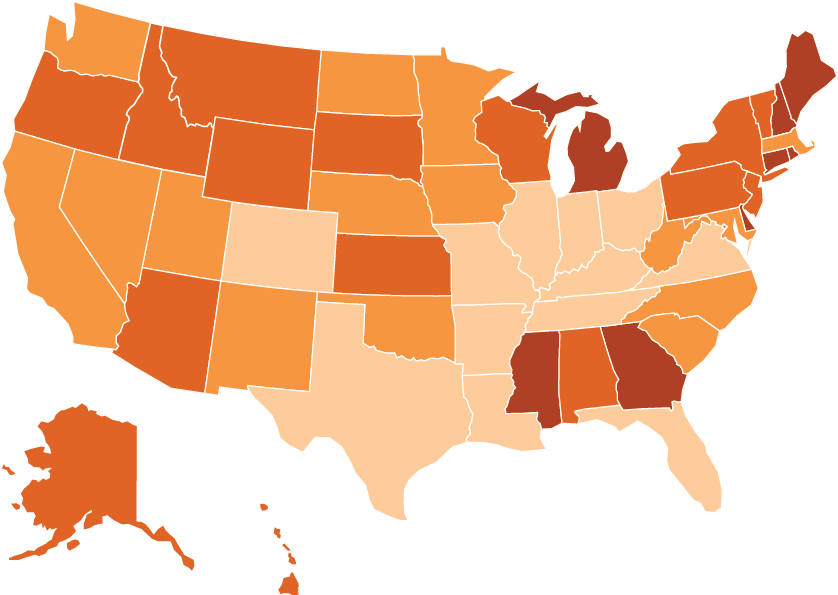
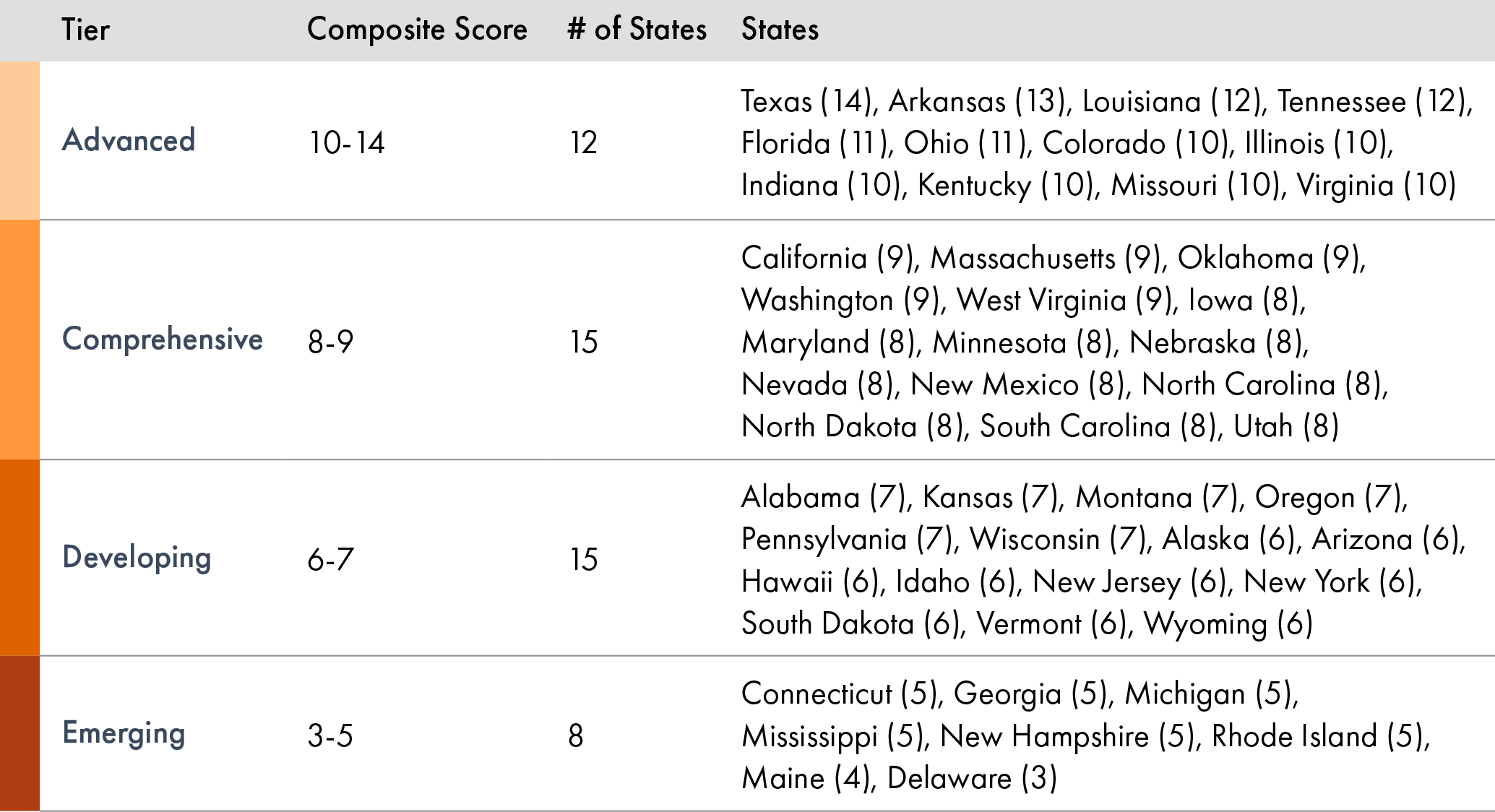
To help policymakers and researchers better understand these differences, HCM developed a typology assessing states across 15 measures of policy engagement.
The framework organizes states into four tiers:
Advanced
Comprehensive
Developing
Emerging
These tiers reflect the breadth of states' approaches to identifying and financing high-priority programs. They are intended to support comparison, inform policy discussions, and identify opportunities for further development — not to rank states based on policy quality or effectiveness.
Explore the High-Priority Program Typology + National Analysis
Use the interactive spreadsheet below to compare how states identify and finance high-priority academic programs.
Navigate the data: Scroll vertically to view all 50 states and horizontally to explore the full range of policy categories and measures.
Understand the scoring: Most measures are binary, with 1 indicating that a state uses the identified policy or practice and 0 indicating that it does not. Two fields — Priority Category and Finance Methodology — are categorical and are not included in scoring.
Interpret the results: The typology reflects the presence and breadth of state policies, not their quality or effectiveness. Higher scores indicate engagement across more measures, rather than better policy outcomes.
The analysis focuses primarily on statewide policies affecting for-credit postsecondary degree programs. Policies established by systems with authority over all public institutions within a sector may also be included. For additional information on field definitions, scoring, and classification criteria, read the full report.
To view the published typology in a new browser tab, click here.
Our analysis reveals widespread state activity, but substantial variation in the approaches states take.
All 50 states have policies for identifying high-priority programs. Every state uses some methodology to identify priority fields, and 49 states offer targeted financial aid to students pursuing designated programs.
States differ significantly in how they identify priorities. Most states rely primarily on occupation-level labor market projections, including anticipated job growth and wages, rather than the actual employment and earnings outcomes of program graduates.
Formal return-on-investment measures are uncommon. Only three states — Arkansas, Ohio, and Texas — have implemented formal ROI metrics connecting program costs to graduates' actual earnings.
Comprehensive approaches are not limited to large or wealthy states. Arkansas joins Florida, Ohio, and Texas among the states demonstrating the broadest policy engagement.
There is no single model for aligning higher education and workforce priorities. States employ different combinations of identification methods, financing mechanisms, and governance structures, reflecting distinct policy priorities and contexts.
To help states benchmark their own practices, the typology sorts all 50 states into four tiers by composite score — Advanced, Comprehensive, Developing, and Emerging — while cautioning that tier placement reflects the breadth of a state's policy engagement, not the effectiveness or quality of any single policy.
About the Research and Methodology
This first-of-its-kind analysis establishes a consistent framework for examining state policies that have historically been difficult to compare across states and policy approaches.
HCM conducted a comprehensive review of state approaches to identifying and financing high-priority academic programs, developed standardized measures for classifying those approaches, and applied the framework across all 50 states.
From List to Lever: A 50-State Typology of How States Identify and Finance High-Priority Programs documents the research approach, definitions, classification criteria, and assumptions underlying the typology, providing transparency into how states were assessed and enabling readers to interpret the findings.
Putting the Research to Work
The typology provides a starting point for states to assess their existing policies and consider how effectively their approaches to identifying and financing high-priority programs work together.
For policymakers, state agencies, and higher education leaders, the framework can help surface important questions: Are states using the right information to identify priority programs? Do funding mechanisms reinforce those priorities? And where might stronger alignment among higher education, workforce, and economic development policies be needed?
By making state approaches more transparent and comparable, this research offers a foundation for more informed policy discussions and future research into which strategies produce meaningful results for students and states.
This research was developed by HCM Strategists to support a more comprehensive understanding of how states identify, prioritize, and finance high-priority postsecondary programs. HCM Strategists welcomes opportunities to discuss the findings of this typology and provide technical assistance to states interested in applying the framework to inform policy and investment decisions.
Questions about the research or interested in applying the framework in your state? Contact HCM Strategists.
Acknowledgements
Tom Allison, HCM’s Director of State Policy and Finance, is the primary author of this report. Muhammad Kara was instrumental in the research and analysis. HCM Strategists is grateful to Strada Education Foundation for their support of this work.
We are also grateful to the following state and national experts who reviewed the typology:
MICHAEL ITZKOWITZ, The HEA Group
TRISTAN DENLEY, Louisiana Board of Regents
FRED CHURCH, Ohio Department of Higher Education
COREY GHEESLING, State Higher Education Executive Officers
RUSSELL VANZOMEREN & JULIA AHRNS-HOFFMAN, Tennessee Higher Education Commission
JENNIFER GONZALES, Texas Higher Education Coordinating Board
WENDY KANG, Virginia Office of Education Economics