NEW: Inside the Balanced Framework: Four Components of State Higher Education Funding


The Balanced Framework Policy Series
About this Series
We’re proud to introduce the Balanced Framework, a signature contribution to HCM’s higher education finance policy work and the first in a new paper series focused on state funding reform.
Each year, states allocate more than $100 billion in public funding to colleges and universities—yet those dollars are not always distributed in ways that are intentional, aligned, or transparent. The Balanced Framework offers a clear, practical model for aligning state appropriations with what matters most: advancing state policy goals, driving equitable student outcomes, and reflecting institutions’ core cost drivers.
Informed by HCM’s direct work with more than 30 states and grounded in research and field best practices, the framework organizes funding formulas into four core components: Core Costs, Enrollment, Progression and Outcomes, and Mission Differentiation. Recognizing that governance structures, student populations, and fiscal conditions vary widely, the model is intentionally flexible—designed to help states tailor funding approaches to their unique context.
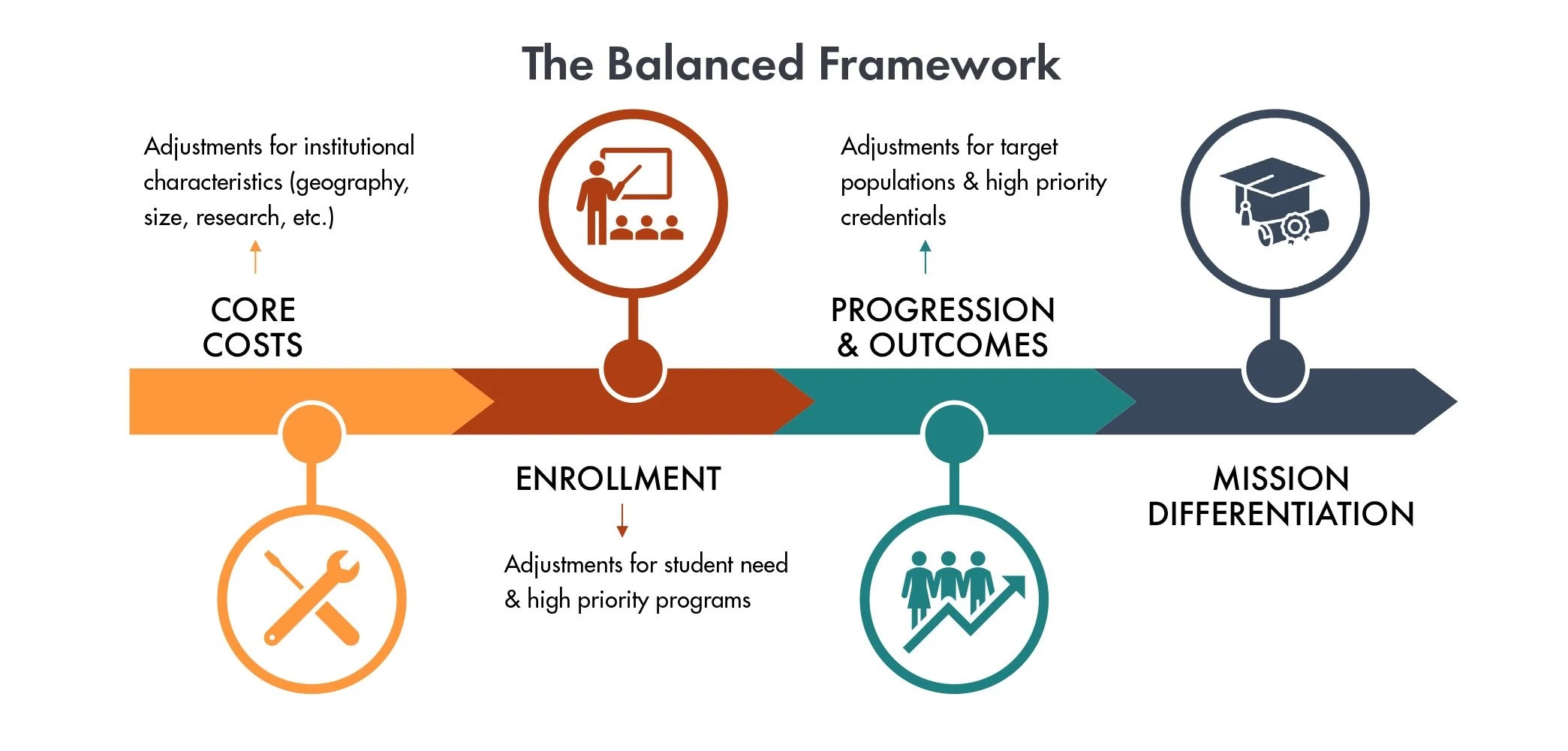
Rather than prescribing a one-size-fits-all formula, the Balanced Framework advances three guiding principles: align funding with state strategy, center student needs and success, and reflect institutional cost realities. By combining multiple funding approaches into a comprehensive model, it addresses the inherent complexity of higher education and provides a durable structure for finance reform conversations—whether resources are abundant or constrained.
This series highlights examples of state funding formulas that balance multiple components and incorporate a range of metrics and adjustments tailored to their unique contexts—similar to the recommendations outlined in the Balanced Framework. The overview report includes case studies of the funding environments in California, Oregon, and Kentucky, and offers a set of guiding questions for state leaders considering funding reform.
Our overview report lays the foundation for the series. The full series will explore each component in greater depth and examine key issues of adequacy, equity, and revenue alignment.
Strategic finance and targeted action can have the biggest impact for states. We look forward to introducing the Balanced Framework to the field and supporting state leaders as they rethink how higher education is funded—and valued.
This series is based on research funded in part by the Gates Foundation. The findings and conclusions contained within are those of the authors and HCM Strategists and do not necessarily reflect positions or policies of the Gates Foundation.